FAIRATMOS EXPERT SERIES: Vanessa’s Journey in Building High-Integrity Carbon Projects
News
Others
 Willie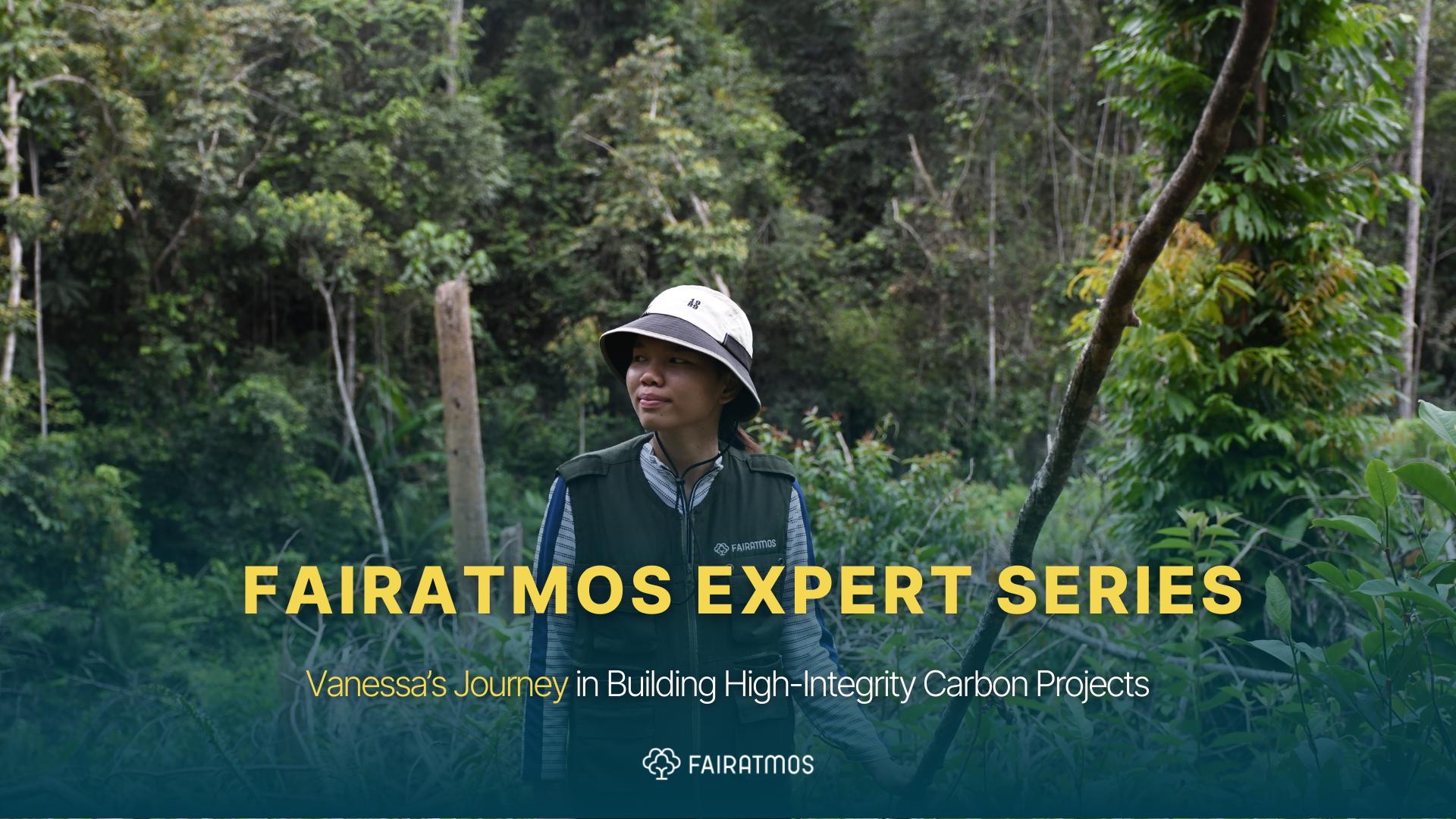
From Forestry Classrooms to Coastal Communities
Vanessa, or Vey as her colleagues call her, is one of the technical experts behind Fairatmos’ blue carbon projects. For Vanessa, forests were never just about trees.
After spending seven years formally studying forestry, with a strong focus on silviculture, she came to understand that ecosystems are never isolated from the people around them. Forests sit at the intersection of ecology, livelihoods, and environmental responsibility.
But that understanding became deeply personal when she began working directly with mangrove ecosystems.
Along Indonesia’s coasts, she spoke with communities whose daily lives depend on mangroves. Their roots protect homes from erosion and storms. Their waters support fisheries that sustain household incomes. Mangroves are not abstract climate solutions, they are living infrastructure.
“At that point, it was no longer just about carbon theory,” she reflects. “It was about people whose lives are closely tied to these ecosystems.” That realization shaped her long-term commitment: to build carbon projects that deliver real ecological recovery and meaningful social impact.
Learning Restoration at National Scale
Her experience deepened when she joined Indonesia’s Peatland and Mangrove Restoration Agency (BRGM), where she worked on large-scale landscape restoration programs.
On paper, restoration appears straightforward: rehabilitate degraded land, plant seedlings, monitor progress, and report results. In reality, it is far more complex.
Progress depends on land tenure clarity, governance capacity, community readiness, and long-term maintenance planning. Even technically sound interventions can fail without sustained coordination and accountability.
This was where Vanessa learned a critical lesson: planting is not the finish line. It is the starting point.
Without structured monitoring and community ownership, seedlings may not survive beyond the first year. And without ecosystem recovery, carbon credits risk becoming numbers disconnected from reality.
That perspective continues to shape how she approaches carbon credit integrity today.
From Standards to Measurable Impact
When Vanessa transitioned to Fairatmos, she was not leaving behind structure, she was adding another layer to it. Her public-sector background trained her to think in terms of safeguards, compliance, and national alignment. At Fairatmos, she sought to strengthen something equally important: measurable impact and continuous improvement.
Every carbon project begins with rigorous site assessment.
Mangrove restoration is not simply about putting seedlings in the mud. It requires understanding tidal patterns, hydrology, sediment stability, and natural species zonation. Many restoration failures stem not from poor seedling quality, but from ecological mismatch.
Success, in her view, is measured by survival rates and ecosystem function, whether mangroves stabilize soil, store carbon long-term, and restore biodiversity. This is what ensures that a carbon offset truly contributes to carbon footprint reduction, rather than existing as a symbolic intervention.
Indonesia’s Blue Carbon Responsibility
Indonesia holds approximately 20 percent of the world’s mangroves, placing the country at the center of global blue carbon potential. Unlike many terrestrial forests that primarily store carbon above ground, mangroves sequester significant amounts of carbon deep within their soils. Waterlogged, oxygen-poor conditions slow decomposition, allowing carbon to remain stored for long periods.
When mangroves are degraded, that stored carbon can be released at scale.
When protected and restored, they become powerful long-term carbon sinks.
This dual reality makes mangrove carbon projects both a major opportunity and a major responsibility.
For companies investing in carbon credits, quality matters. A blue carbon project must represent long-term ecosystem protection, not just planting activity. Integrity is built through science, monitoring, and adaptive management.
Restoration Is Also About People
For Vanessa, restoration is never purely technical.
In many coastal communities, women play a critical yet often under-recognized role in mangrove management. They collect propagules, manage nurseries, prepare seedlings, and increasingly participate in field monitoring.
As a woman in a field often perceived as male-dominated, Vanessa challenges the assumption that technical capability is defined by gender.
“Competence in forestry comes from curiosity, resilience, and responsibility,” she says.
At Fairatmos, inclusion is embedded at the planning stage. Women are not positioned merely as labor participants, but as contributors to consultation, planning, and benefit-sharing mechanisms. Restoration success depends not only on ecological recovery, but on community ownership.
When people see mangroves as part of their future, long-term impact becomes possible.
Building Natural Infrastructure for the Next Generation
Looking ahead twenty years, Vanessa does not see mature mangroves simply as carbon stock.
She sees natural infrastructure.
Healthy mangrove ecosystems can protect homes from storm surges and erosion, support fisheries and sustainable livelihoods, improve water quality, and enhance biodiversity, while continuously storing carbon. A well-designed carbon project, in her view, becomes a legacy.
Carbon credits should not only compensate emissions. They should represent restored landscapes, strengthened communities, and durable climate mitigation.
Through rigorous science, structured monitoring, and inclusive engagement, carbon projects can move beyond numbers and become living systems.
Because in the end, restoration is not just about planting trees.
It is about rebuilding ecosystems.
It is about people.
It is about the future.
For Buyers & Investors
Explore verified, high-impact projects like this through AtmosFund & invest in the future of sustainable landscapes.
Explore AtmosFundFor Landowners & Project Starters
Learn how your land could qualify for carbon project development through AtmosCheck.
Sign Up Now